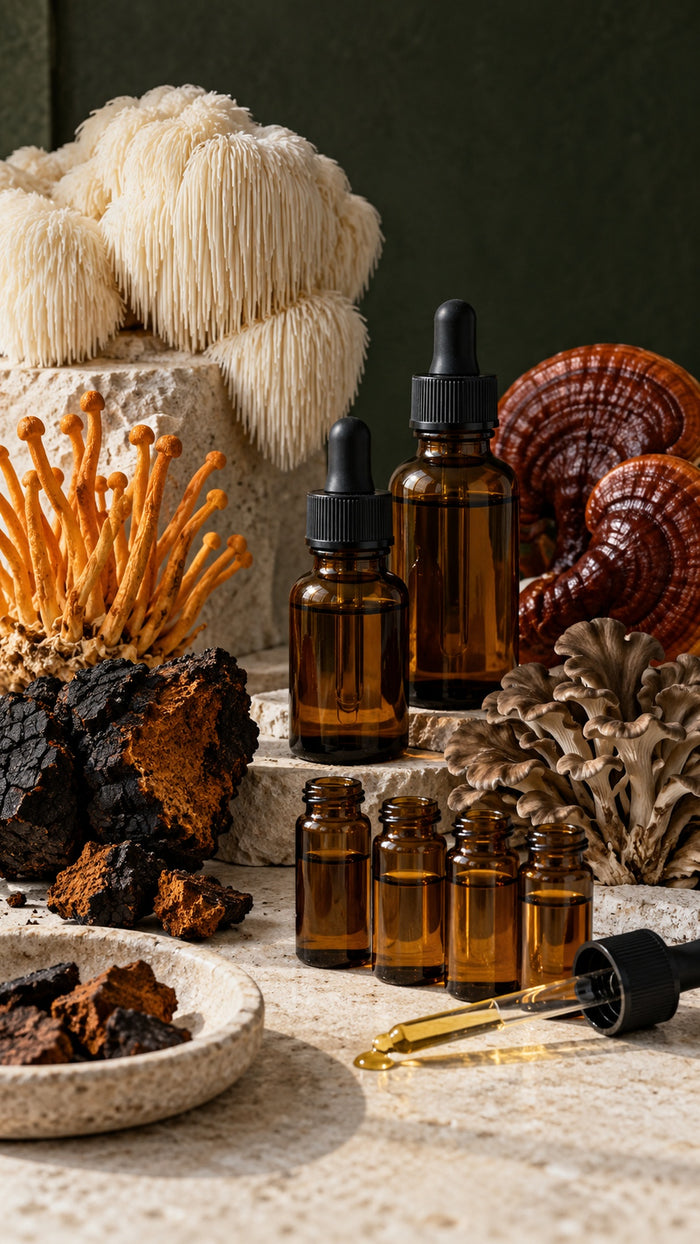
What Is Biocatalyst Based Triple Stage Extraction? How Vital Vial Extracts More From Functional Mushrooms

Most mushroom extracts stop at one or two stages. Vital Vial does not.
When you see the word "extract" on a mushroom supplement, it tells you very little on its own. It does not tell you what was extracted, how much was recovered, or whether the compounds that actually matter survived the process. Extraction method is where the real differentiation lives, and most brands do not explain theirs in any meaningful way.
This article explains exactly what biocatalyst based triple stage extraction is, why we built our process around it, and what our lab data shows about the difference it makes compared to conventional dual extraction.
What conventional dual extraction does and where it falls short
Standard dual extraction uses two solvents: hot water and ethanol. Hot water pulls out the water soluble compounds, primarily beta glucans. Ethanol pulls out the alcohol soluble compounds, including hericenones in Lion's Mane.
That covers the basics. But there is a structural problem with stopping there.
Mushroom cell walls are built from chitin, the same tough polysaccharide that makes up the shells of insects and crustaceans. Chitin does not dissolve in water or ethanol. That means a significant portion of the bioactive compounds locked inside those cell walls never fully enter the extract. You end up with a liquid that looks potent but leaves real yield on the table.
Also read: Fruiting Body vs Mycelium: What's the Difference?
What biocatalyst based extraction adds to the process
This is not a shortcut or an additive. The bio-catalyst is a processing aid that degrades the physical barrier between the solvent and the intracellular compounds. It is removed from the final extract after its job is done.
The result is that when the hot water and ethanol stages follow, they are working on material that is already structurally opened. More surface area. More compound availability. Higher recovery per gram of input material.
The three stages, in plain language
What our lab data shows
The finished Vital Vial Lion's Mane liquid extract contains 3 to 4% beta glucan by volume, verified by the Megazyme mixed linkage assay on every production batch. That number reflects what is actually in the bottle, not what was present in the raw mushroom before processing losses.
For context, most liquid mushroom extracts on the Australian market either do not disclose beta glucan content at all, or report it from the dry input material rather than the finished liquid. A product quoting 30% beta glucans on the raw powder tells you nothing about how much survived dilution, filtration, and standardisation into the final format you consume. The 3 to 4% figure we publish is the number that matters: it is the concentration in the liquid as delivered.
Hericenone yield follows the same principle. HPLC analysis of hericenone B and hericenone C is run on the finished extract, not the intermediate fraction, so the figures on our COA reflect the actual product rather than an upstream measurement inflated by process losses downstream.
Our batch specific Certificates of Analysis are available for every production run. You can verify these numbers yourself rather than taking our word for it.
Also read: What Is a Certificate of Analysis (COA) for Mushroom Supplements?
Why the source material still matters
A better extraction process cannot compensate for poor input material. Our Lion's Mane extract starts with 100% fruiting body, harvested at the stage of development where beta glucan and hericenone concentrations peak. No mycelium. No grain substrate filler. The fruiting body specification is non negotiable for us because it is where the compounds actually concentrate.
Mycelium based products often test low in beta glucans and high in alpha glucans, which come from the grain substrate rather than the mushroom. An extraction process, no matter how sophisticated, does not turn substrate starch into medicinal polysaccharides.
Also read: Inside Extraction Science
What this means when you are choosing a mushroom extract
Most supplement labels will not tell you the extraction method. They will not show you the in process beta glucan test. They will not give you an HPLC figure for hericenones. That absence of data is itself a signal.
When evaluating any functional mushroom supplement, the questions worth asking are: Is the source material fruiting body only? What extraction method was used and at what temperature? Is beta glucan content measured by the Megazyme method or a generic polysaccharide assay? Are hericenones measured by HPLC? And is there a batch specific COA that reports the finished liquid, not the raw powder?
If the brand cannot answer those questions, the product cannot be verified. Verification is the whole point.
Also read: What Should I Look for in a Lion's Mane Supplement?
The Vital Vial approach in summary
Biocatalyst based triple stage extraction exists because conventional dual extraction leaves too much behind. By opening the cell wall before the solvent stages begin, we recover significantly more of the compounds that matter. Our finished liquid delivers 3 to 4% beta glucan by volume, measured by Megazyme, with hericenones confirmed by HPLC, from fruiting body material with no substrate contamination.
Our lab data supports this. Our COAs document it batch by batch. And our Lion's Mane Liquid Extract is the direct product of this process.
Also read: What Is Lion's Mane Extract Used For?
If you want to understand what is actually in your mushroom supplement, start with the extraction method. It determines everything downstream.
Written by
Priyanka Mishra