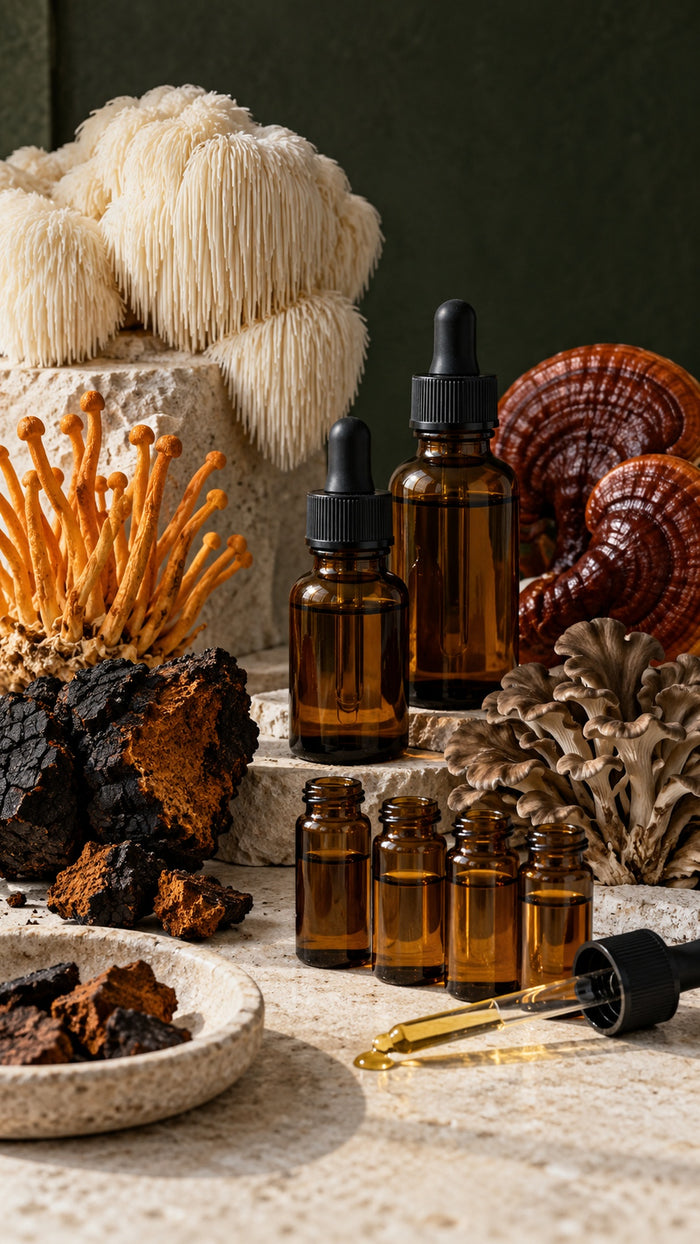
Why Mushroom Extraction Matters: What Happens During the Extraction Process?

Walk down any health food aisle or scroll through any mushroom supplement brand's website and you will see the word extract on almost every product. It is meant to signal potency. The implication is that something has been concentrated, purified, or made more bioavailable than raw dried mushroom powder.
In many cases, that is true. But extraction is a process with real variables, and those variables determine whether what ends up in the bottle is genuinely potent or just processed. This article explains what extraction actually does, what can go wrong at each stage, and why the beta glucan figure in the finished liquid is the only number worth paying attention to.
What extraction is trying to do
Functional mushrooms contain compounds that are not freely available when you simply eat or powder the raw fruiting body. Beta glucans, the primary bioactive polysaccharides, are bound within the cell wall structure of the mushroom. Hericenones in Lion's Mane are soluble in alcohol but not in water. Triterpenoids in Reishi require a different solvent again.
Extraction uses heat, water, alcohol, or other methods to break the mushroom's cell structure and pull these compounds out of the solid material into a liquid where they can be concentrated, standardised, and consumed. The goal is to make bioavailable what would otherwise pass through your digestive system largely intact.
The problem is that the efficiency of that process varies enormously depending on the method used, the quality of the source material, and how the finished extract is measured and reported.
The chitin problem that most brands skip over
Mushroom cell walls are built primarily from chitin, the same structural polysaccharide that forms the exoskeletons of insects. Chitin is highly resistant to both water and ethanol, the two solvents used in standard dual extraction.
This creates a structural barrier problem. When you put dried mushroom material into hot water, the water can only access the compounds that are exposed on the surface or in damaged cells. A significant fraction of the beta glucans and other intracellular compounds remain locked behind the intact chitin wall, unreached by the solvent, and lost in the spent material that gets filtered out after extraction.
Most dual extraction processes do not address this. They rely on the solvent doing the work, which it can only do partially when the cell wall is intact.
What happens at each stage of a triple stage extraction
At Vital Vial, we use a three stage process specifically designed to address the chitin barrier before the solvent stages begin.
The enzymatic stage. Before any solvent is applied, the dried fruiting body material is treated with a cellulase and chitinase enzyme blend at a controlled temperature between 45 and 52 degrees Celsius. The enzymes break down the chitin matrix and open the cell wall structure, exposing the intracellular compounds to the solvents that follow. The enzyme is a processing aid, not an ingredient. It is fully removed in the filtration stage before the extract is standardised.
The hot water stage. Once the cell wall has been degraded, high temperature aqueous extraction at 85 to 95 degrees Celsius pulls the water soluble compounds into solution. This is primarily the beta glucan fraction. We test this fraction using the Megazyme mixed linkage assay at this stage, before we proceed, to confirm the yield is within specification.
The ethanol finishing stage. A controlled ethanol wash follows to extract the alcohol soluble compounds, including hericenone B and hericenone C in Lion's Mane. These are measured by HPLC. The two extracts are then combined, filtered, and concentrated into the finished liquid.
Why the finished liquid figure is the only number that matters
Here is where most mushroom supplement marketing breaks down.
Many brands report beta glucan content from the raw dry powder, before dilution into a liquid format. A product quoting 30% or 40% beta glucans is almost certainly reporting the concentration in the dry input material or an intermediate extract, not in the finished liquid you actually consume.
The Vital Vial Lion's Mane liquid extract delivers 3 to 4% beta glucan by volume in the finished product, measured by the Megazyme assay on every production batch. That figure accounts for the full process: the enzymatic pretreatment, the hot water extraction, the concentration step, and the final standardisation into the liquid format.
Three to four percent beta glucan by volume in a liquid extract is a meaningful, verifiable number. A 30% figure on a dry powder that dissolves into a tiny capsule, or that gets heavily diluted into a liquid without disclosed volume data, cannot be directly compared to it.
The question to ask of any mushroom supplement is: is this the concentration in the finished product I am consuming, measured by a validated method, from a batch specific COA?
Also read: What Is a Certificate of Analysis (COA) for Mushroom Supplements?
What poor extraction looks like in practice
The markers of an under extracted or poorly processed mushroom supplement are fairly consistent.
No disclosed extraction method is the most common flag. If a brand does not tell you whether they use hot water, dual extraction, or a more advanced process, they are not confident in their method. Opacity about process almost always reflects a process not worth promoting.
Beta glucan content reported on the dry material, not the finished product, is the second flag. The math of dilution means a high dry weight percentage can become a low finished product concentration. The two numbers are not interchangeable.
Mycelium sourced material is the third flag. Mycelium grown on grain substrate accumulates alpha glucans from the starch, not beta glucans from the mushroom. A Megazyme assay will distinguish the two. Many products reporting high beta glucan content from mycelium are actually measuring alpha glucans from the grain, which do not carry the same bioactivity.
Also read: Fruiting Body vs Mycelium: What's the Difference?
What to verify before buying any mushroom extract
The minimum standard for a verifiable mushroom extract is: fruiting body source, a disclosed extraction method, beta glucan content measured by Megazyme reported in the finished product format, and a batch specific COA from an independent laboratory.
If the product page does not include these, the information may still exist. Ask for it. A brand with nothing to hide will produce the COA within minutes. A brand that deflects or offers a generic certificate not tied to a specific production batch is telling you something about how seriously they treat verification.
Also read: What Should I Look for in a Lion's Mane Supplement?
Why extraction method is a brand integrity question, not just a science question
The functional mushroom market in Australia is growing quickly and regulatory oversight on supplement potency claims is limited. In that environment, a brand's extraction process and its willingness to document it publicly is one of the strongest signals of integrity available to a consumer.
Anyone can put the word extract on a label. Fewer brands will show you the Megazyme assay result, the HPLC trace for hericenones, and the batch number on the COA that ties the certificate to the product in your hand.
At Vital Vial, those documents exist for every batch. The 3 to 4% beta glucan figure in our Lion's Mane Liquid Extract is not a marketing claim. It is a measurement, repeated across batches, using a validated method, from 100% fruiting body material with no substrate filler.
Also read: What Is Lion's Mane Extract Used For?
Extraction is where the real work happens. The label is just the summary.
Written by
Priyanka Mishra