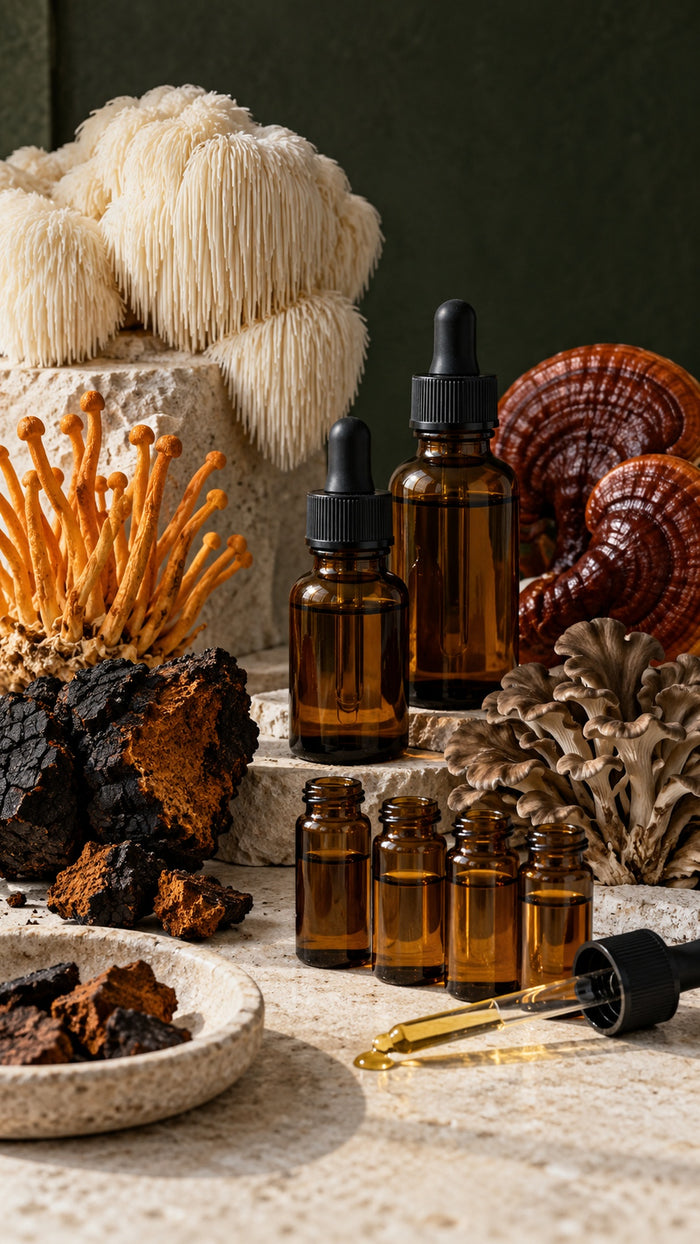
Liquid Mushroom Extract vs Powder: What's the Difference?

Most people asking this question have already decided they want a mushroom extract. The format question comes second, and it deserves a straight answer rather than brand-driven deflection.
Liquid and powder extracts are not two versions of the same thing. They are produced differently, they behave differently in the body, and they serve different practical purposes. Understanding why matters more than picking a winner.
How Each Format Is Made
Powder extracts are typically produced through a hot water extraction or dual extraction process applied to dried mushroom material, often fruiting bodies. The resulting liquid is then spray dried or freeze dried into a concentrated powder. That final drying step is what separates powder from liquid in a meaningful way: it introduces heat, removes water, and depending on the method, can affect certain heat sensitive compounds.
Liquid extracts skip that drying step entirely. The extracted material stays in solution. This means the active compounds remain in their dissolved state, which is how they would need to be for absorption through mucosal tissue and the digestive tract anyway.
At Vital Vial, the Lion's Mane liquid extract is produced using a hot water and enzyme assisted extraction process applied directly to the fruiting body. No mycelium on grain. No spray drying. The final product is a concentrated liquid measured for beta glucan content in the finished state, not at an intermediate stage before drying.
That last point matters more than it sounds.
The Beta Glucan Measurement Problem
Beta glucans are the primary functional polysaccharides in Lion's Mane and the compound most researchers tie to immune modulation and neuroprotective activity. They are also the compound most commonly misreported on supplement labels.
The issue is measurement timing. A powder manufacturer can measure beta glucan content in the extract before spray drying, report that number on the label, and never account for what the drying process does to solubility and structural integrity. This is not a rare edge case. It is a common gap between reported and actual potency in the powder category.
Liquid extracts measured in their final form do not have this gap. What the COA says is what is in the bottle. The Vital Vial batch COA reflects beta glucan content of the finished liquid product, measured post extraction and post enzyme processing, not at a pre drying stage.
This is the kind of specificity that is worth asking every brand about, regardless of format.
Absorption and Delivery
This is where the format difference becomes physiologically relevant.
Powder extracts, once ingested, have to go through re dissolution in the gut before absorption can begin. For many compounds this is a minor delay. For polysaccharides like beta glucans, which have complex molecular structures and limited passive diffusion across intestinal membranes, the dissolution environment matters. A powder that was not fully water soluble before drying may have bioavailability that does not match the label concentration.
Liquid extracts in an aqueous base are already in solution. There is no dissolution step. The compounds are presented to the mucosal surface and gastrointestinal tract in a form that mirrors how the body is designed to encounter water soluble compounds. This is not a guarantee of superior absorption in every individual case, but it removes one variable that powder formats introduce.
Sublingual delivery, placing the liquid under the tongue before swallowing, adds another layer. The sublingual mucosa allows certain compounds to enter circulation without going through first pass liver metabolism. Not all mushroom extract compounds are well absorbed this way, but the option exists only with a liquid format.
Concentration and Dose Accuracy
Powders can be concentrated to very high ratios, which is useful if you need to pack a large dose into a small capsule. A 10:1 or 20:1 powder extract is not inherently better than a 1:1 liquid, but the numbers do reflect how much raw material went into producing a given unit of product.
Liquid extracts are harder to compare on ratio alone because the concentration depends heavily on the extraction solvent volume and how much of it is retained in the final product. A well formulated liquid extract will have a defined milligram equivalent per millilitre, ideally verified by third party COA.
The honest answer is that concentration ratios across formats are not directly comparable without knowing the extraction method, the solvent, the starting material quality, and what was actually measured post process. Anyone telling you a powder is automatically stronger because of its ratio, or a liquid is automatically more bioavailable across the board, is simplifying past the point of accuracy.
Practical Considerations
Powder extracts are easier to travel with, easier to stack into a smoothie or coffee, and have longer shelf stability when stored dry. They are a reasonable format for people who want a flexible, unflavoured base to add to food.
Liquid extracts require more careful storage, typically refrigeration after opening, and come with a finite shelf life once the bottle is open. But they offer dosing precision that capsules and scoops cannot match. A dropper allows fractional dosing, which is useful when titrating up to an effective amount or managing sensitivity.
For people who have difficulty swallowing capsules, or who want to avoid the excipients that hold most powders into tablet or capsule form, liquid is the cleaner option.
What the Research Actually Compares
Published research on Lion's Mane functional activity, including work by Mori et al. on nerve growth factor stimulation and studies on hericenones and erinacines, is mostly done with standardised extracts in liquid or dissolved powder form. Very little of the existing clinical literature directly compares liquid versus powder delivery formats head to head.
This is worth being clear about. The format comparison you will find in most supplement marketing is extrapolated from absorption physiology and formulation science, not from direct clinical trials showing that one format outperforms the other in a human population. Both formats can work. The quality of the extraction and the integrity of the active compounds matter more than the format choice alone.
Also Read
- What Is Lion's Mane Mushroom?
- How Does Lion's Mane Extract Work?
- What Is Lion's Mane Mushroom Used For?
- Lion's Mane Extract: What Should You Look For?
Frequently Asked Questions
What is the main difference between liquid and powder mushroom extract?
Liquid extracts remain in an aqueous solution from extraction through to consumption. Powder extracts go through a drying step after extraction, which introduces additional processing variables including heat exposure and changes to compound solubility. Both can deliver functional actives, but the production path and how compounds behave at the point of absorption differ between them.
Is liquid mushroom extract more bioavailable than powder?
Liquid extracts remove the dissolution step that powder formats require in the gut, which in theory simplifies the absorption process for water soluble compounds like beta glucans. However, direct head to head clinical comparisons between liquid and powder formats in humans are limited. Quality of extraction and compound integrity in the finished product matter more than format alone.
Can you take liquid mushroom extract sublingually?
Yes. Placing a liquid extract under the tongue before swallowing allows some compounds to be absorbed through the sublingual mucosa, bypassing first pass liver metabolism. This option is not available with powder or capsule formats.
How do you know what concentration a liquid extract actually is?
Look for a third party COA that measures active compound content, particularly beta glucans, in the finished liquid product. The measurement should be post extraction and post any processing steps, not reported from an intermediate stage. Vital Vial publishes batch specific COA data for this reason.
Does a higher concentration ratio mean a powder extract is stronger?
Not necessarily. Concentration ratios across formats are not directly comparable without knowing the extraction method, the starting material, and what was measured after processing. A 10:1 powder and a well formulated liquid extract cannot be reliably ranked on ratio alone.
Which format is better for travel or everyday use?
Powder and capsule formats have practical advantages for travel and mixing into food. Liquid extracts require refrigeration after opening and more careful handling, but offer more precise dosing and fewer excipients. The better format depends on your lifestyle and how you prefer to use the supplement.
Does Vital Vial use fruiting body or mycelium in its liquid extract?
Vital Vial uses fruiting body material. Mycelium on grain products are excluded from the formulation because they dilute functional actives with grain starch, which can inflate polysaccharide readings without adding genuine beta glucan content.
Written by
Priyanka Mishra