What Does "100% Fruiting Body" Mean on a Mushroom Supplement Label?

Walk through the mushroom supplement aisle and you will see the phrase everywhere. "100% fruiting body." It appears on jars, pouches, and product pages as a marker of quality. But most buyers have no idea what it actually means, or why it matters enough to advertise.
This guide unpacks the claim with precision. What the fruiting body is, why some manufacturers use a different part of the fungus entirely, and how to read a label to tell the difference.
The Anatomy of a Fungus
A mushroom is not a single organism in a simple sense. It is the reproductive structure produced by a much larger fungal network. That network, called mycelium, spreads through a substrate underground or through whatever material the fungus colonises.
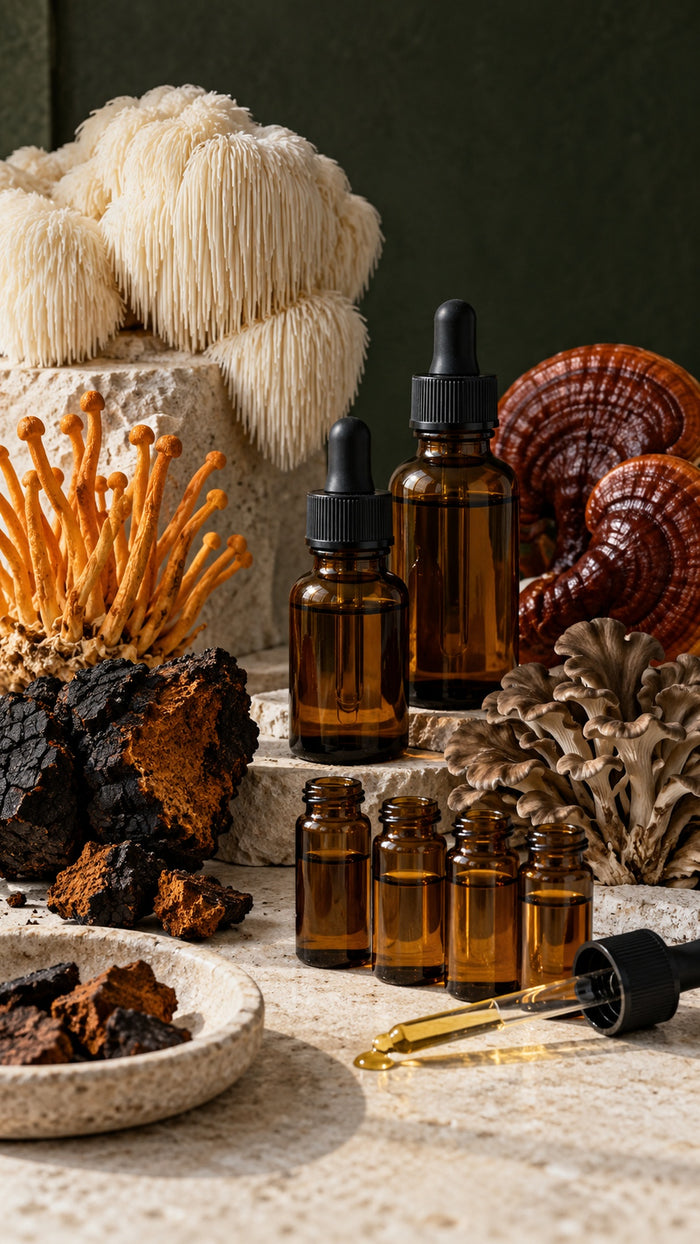
The fruiting body is what most people recognise as the mushroom itself: the cap, the stem, and the visible flesh. It is where the fungus concentrates its secondary metabolites, including the beta glucans, terpenoids, and other bioactive compounds that researchers have studied extensively.
The mycelium, by contrast, is a vegetative structure. It does contain some bioactive compounds, but in lower concentrations. And when manufacturers grow mycelium commercially, they typically do so on a grain substrate such as oats, rice, or brown rice flour. That substrate does not get fully separated from the mycelium before processing. The result is a powder that contains significant amounts of grain starch alongside whatever fungal content is present.
Why "Mycelium on Grain" Became Common
Cultivating fruiting bodies takes longer and requires more controlled conditions. Traditional fruiting body cultivation, particularly for species like Lion's Mane, demands humidity chambers, precise temperature cycles, and weeks of growth time before harvest.
Mycelium on grain can be produced faster and at lower cost. Manufacturers inoculate grain, allow mycelium to colonise it, then dry and grind the entire mixture. The result is a high volume product that is significantly cheaper to produce.
The problem is disclosure. For years, many products using mycelium on grain listed their ingredient simply as "mushroom mycelium" or even just the species name, without making clear that the product contained substantial amounts of grain filler. Independent testing has repeatedly found that products made this way have much lower beta glucan content and measurable levels of starch that should not be present if the product were purely fungal.
What Beta Glucan Content Actually Tells You
Beta glucans are polysaccharides found in the cell walls of fungi. They are the primary bioactive compounds that most mushroom supplement research has focused on, and they serve as the most reliable proxy for potency in a finished product.
A high quality fruiting body extract typically contains between 25% and 45% beta glucans by dry weight, depending on the species and extraction method. Lion's Mane fruiting body extracts from reputable producers generally test between 30% and 40%.
Mycelium on grain products frequently test below 10%, and sometimes below 5%. Some independent analyses have found beta glucan levels consistent with the grain substrate itself rather than any meaningful fungal content.
This is why beta glucan content, not the extract ratio or the total weight, is the number that matters most on a supplement label.
Extraction Method Matters Too
Even within fruiting body products, there is meaningful variation depending on how the material is processed.
Hot water extraction is the traditional method. It makes beta glucans and other water soluble compounds bioavailable by breaking down the chitin in fungal cell walls. Without extraction, most of the beta glucan content in raw or dried mushroom powder passes through the digestive system without being absorbed.
Dual extraction adds an alcohol step to the process, which pulls out fat soluble compounds like triterpenes. For species such as Lion's Mane, which also contains hericenones and erinacines as key bioactive compounds, dual extraction can produce a more complete spectrum product.
Enzyme assisted extraction is a newer approach. It uses targeted enzymes to break down cell wall structures without heat degradation, which may preserve certain heat sensitive compounds. Third party tested beta glucan retention in enzyme assisted extracts is an area of ongoing evaluation.
A label that says "100% fruiting body" but does not specify extraction method may still be selling you raw dried powder rather than a true extract. Always look for extract ratio notation (for example 8:1 or 10:1) alongside beta glucan content to understand what you are actually getting.
How to Read a Label
Here is what to look for when evaluating a mushroom supplement claim:
Ingredient declaration: The ingredient list should specify "fruiting body" explicitly. If it says "mycelium," "myceliated grain," or just the species name with no qualifier, the source is ambiguous at best.
Beta glucan content: This should be listed as a percentage on the supplement facts panel. If it is not listed at all, or if it is listed alongside starch content that is suspiciously high, the product likely contains significant grain material.
Extraction ratio: A ratio like 8:1 or 10:1 tells you how many kilograms of raw material were used to produce one kilogram of extract. Higher ratios generally indicate more concentrated bioactive content, but they should always be cross referenced against actual beta glucan testing, not taken at face value.
Certificate of Analysis: A credible supplier will provide batch specific COAs from an independent third party laboratory. These documents show the actual tested beta glucan content, heavy metals screening, microbial testing, and sometimes starch content. If a company cannot provide a COA for the specific batch you are purchasing, that is a significant gap in transparency.
Substrate disclosure: Fruiting body products should be grown on wood based substrates, typically hardwood sawdust or logs, which is the natural environment for most medicinal species. Grain substrate use should prompt scrutiny about whether the product is truly fruiting body only.
Why Vital Vial Uses Fruiting Body Extracts
Every Vital Vial product is made exclusively from fruiting body material. No mycelium on grain. No grain filler. The extraction process targets bioavailable beta glucan content, and every batch is tested by an independent laboratory before it reaches customers.
Our Lion's Mane Extract is a dual extracted fruiting body product with batch specific COA documentation available for every production run. If you want to see the actual tested beta glucan percentage for the batch you are considering, that data is accessible before you buy.
That level of transparency is not common in this category. We think it should be the baseline.
The Short Version
"100% fruiting body" means the product is made from the actual mushroom, not the underground fungal network grown on grain substrate. It signals that you are getting a product with higher bioactive compound concentration and no grain starch diluting the dose.
But the phrase alone is not enough. Pair it with third party tested beta glucan content and a batch specific COA, and you have a genuinely useful quality signal. Without those, it is just marketing language.
For a deeper look at how to evaluate Lion's Mane products specifically, see our guide to choosing a Lion's Mane supplement. For an overview of the research behind the fruiting body, see our Lion's Mane research overview.
Written by
Priyanka Mishra