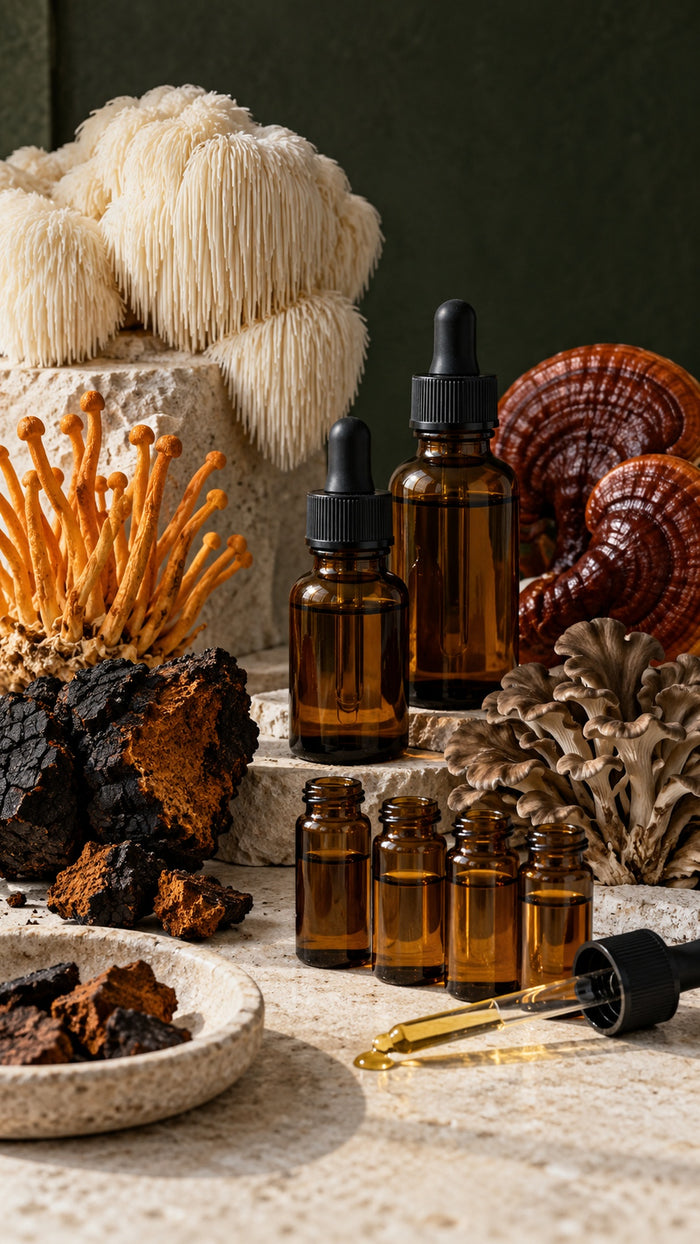
The Difference Between Lion's Mane Mushroom and Lion's Mane Extract

Is eating Lion's Mane the same as taking Lion's Mane extract? Not quite. Both come from the same mushroom, but the extract has been processed to separate certain compounds from the raw material, while the whole mushroom is simply eaten as food.
That's the short answer to the difference between Lion's Mane mushroom and Lion's Mane extract. The rest of this article covers how they differ in form, processing, composition and labelling, and what to look for if you're shopping for an extract in Australia. We're not saying one is better. It depends on what you want and what's actually in the product.
What is Lion's Mane mushroom?
Lion's Mane (Hericium erinaceus) is an edible mushroom that looks nothing like the typical button mushroom. It grows as a white, shaggy cluster of soft spines, a bit like a pom-pom or, if you squint, a lion's mane. It's cooked in a lot of East Asian cuisine, and the texture when sautéed is often compared to crab or scallop.
You'll find it in two main forms:
- Fresh: cooked like any other mushroom. It's mostly water, so it doesn't keep long.
- Dried: shelf-stable, and often ground into a powder for teas, smoothies or capsules.
Like other mushrooms, Lion's Mane contains naturally occurring compounds, including polysaccharides such as beta-glucans and various other molecules that researchers continue to study (Friedman, 2015). Research is ongoing and still developing, so it's best to treat any big claims about benefits with caution. If you're curious about Lion's Mane mushroom benefits, the honest position is that the science is early and no food or supplement replaces medical advice.
What is Lion's Mane extract?
An extract starts with mushroom material (more on which parts below) and uses a solvent, such as water or alcohol, to pull out selected compounds. The liquid is then used as is, or concentrated and dried into a powder.
So a mushroom extract isn't the mushroom in a smaller package. It's a different product made from it, with a composition that depends on how it was made.
Extracts come in a few common forms:
- Liquid extracts, usually taken by dropper or added to a drink.
- Powdered extracts, sold as loose powder or in capsules.
Two brands can both say "Lion's Mane extract" and still be quite different. The raw material, the solvent, the temperature and the number of extraction steps all shape the result.
The main differences at a glance
| Whole Lion's Mane mushroom | Lion's Mane extract | |
|---|---|---|
| Form and preparation | Fresh or dried; cooked, brewed or ground | Liquid or powder; often ready to take |
| Processing | Minimal (cooking, drying, milling) | Solvent extraction, then concentration or drying |
| Composition | Contains everything in the mushroom, including fibre and starch | Contains the compounds the process recovers; the rest is mostly removed |
| Concentration | Not applicable; it's the raw material | Varies; often shown as an extract ratio |
| Convenience | Needs storing, cooking or preparing | Easy to measure and take |
| Labelling and quality information | Usually limited to the food label | Should include the source, method and, ideally, test results |
One thing to be clear about: an extract isn't automatically more effective than the whole mushroom. What you get depends on the raw material, the method and the finished product.
How does extraction change Lion's Mane?
Different solvents pull out different things, and this is the main reason extracts vary.
Hot-water extraction is the traditional approach. Simmering the mushroom in water draws out water-soluble compounds, including beta-glucans.
Alcohol extraction uses ethanol to recover compounds that don't dissolve well in water.
Combined (dual) extraction uses both, so the final product can include water-soluble and alcohol-soluble compounds.
Each method recovers a different mix of compounds. That's why an extract ratio alone tells you very little about quality. Two extracts with the same ratio can have quite different profiles.
Vital Vial uses a proprietary enzyme-based triple-stage extraction for its Lion's Mane. It's a point of difference from standard single-step methods, though we won't make claims about absorption or potency that we can't back up. If you want the specifics of how it works, the Lion's Mane Liquid Extract product page is the place to check, and the brand's approach to manufacturing is explained on the About page.
Is Lion's Mane extract more concentrated than the whole mushroom?
Sometimes, in a sense, but "concentrated" needs unpacking.
Most extracts are labelled with a ratio like 10:1. That generally means about 10 parts of raw mushroom went into making 1 part of extract. It describes how much starting material was used, not how much of any particular compound ended up in the bottle.
There are a few limits to keep in mind:
- The ratio doesn't say whether it was calculated on fresh or dried mushroom, which changes the meaning a lot.
- It doesn't say which compounds were recovered.
- A high ratio can still contain a lot of filler or starch.
So a bigger number isn't a reliable sign of a better product. Look at the actual specifications, and at test results where they're available.
What about beta-glucans in Lion's Mane?
Beta-glucans are a type of polysaccharide (a long chain of sugar molecules) found in the cell walls of fungi. They're commonly measured in mushroom extracts because they're one of the better-studied compound groups in mushrooms, and because they give a more specific marker than a general ratio.
It also helps to know the difference between two terms that get mixed up:
- Total polysaccharides includes every kind of polysaccharide, including starch and other sugars that aren't beta-glucans.
- Beta-glucans are a specific subset, and are usually measured with a targeted test that separates them from starch-type glucans.
A product can report a big polysaccharide number and still have a modest beta-glucan figure. That's why it pays to check which one the label is quoting.
Vital Vial reports Lion's Mane beta-glucan content of 3–4% by volume. Note the "by volume" part, because it's the measurement basis for a liquid and shouldn't be compared straight against a percentage by weight on a powder. A higher percentage also isn't proof of a better or more effective product. It's one data point among several.
Which should you choose: whole mushroom or extract?
Neither is universally better. It comes down to how you want to use it.
The whole mushroom suits you if you enjoy cooking with it or want it as a food. You'll need to source it fresh or dried, prepare it, and accept that there's no standard dose.
An extract suits you if convenience matters, or if you'd like a measured serve and product information you can compare. Liquid extracts are easy to add to drinks, while powders and capsules suit people who prefer them.
If you're weighing up Lion's Mane mushroom powder vs extract, the difference is mainly processing. A powder is dried, ground mushroom, so it still contains everything in the mushroom, including the fibre. An extract has been through a solvent process first.
If you have a health condition, take medication or are pregnant, it's worth speaking to a doctor or pharmacist before starting any supplement.
What to check before buying Lion's Mane extract in Australia
If you're shopping for Lion's Mane extract in Australia, these are worth a look:
- Fruiting body or mycelium. The fruiting body is the mushroom you'd recognise. Mycelium is the root-like network, often grown on grain, and grain starch can end up in the final product. The label should say which one is used.
- Extraction method. Water, alcohol or both? Brands should be willing to say.
- Extract ratio, and what it's based on. Remember it's a starting-material measure, not a potency guarantee.
- Beta-glucan information. Look for a stated figure and the basis it's measured on.
- Full ingredient list. Check for fillers, carriers and additives.
- Independent laboratory testing. Third-party testing is more reassuring than in-house claims.
- Certificate of Analysis (COA). A COA shows test results for a specific batch.
- Manufacturer transparency. Who makes it, where, and how easy is it to find out?
As one example, Vital Vial is an Australian functional mushroom brand, and its Lion's Mane Liquid Extract is made using fruiting bodies only, with independent batch testing and Certificates of Analysis available. Whichever brand you're considering, it's fair to hold it to the same checklist.
Frequently asked questions
Is Lion's Mane mushroom the same as Lion's Mane extract?
No. The extract is made from the mushroom, but it has been processed to separate certain compounds, so the composition is different.
Is Lion's Mane extract more concentrated than the whole mushroom?
It can be, depending on the ratio, but the ratio only reflects how much raw material was used. It doesn't tell you how much of any specific compound is in the product.
Does Lion's Mane extract contain more beta-glucans?
Not necessarily. It depends on the source material and the method, and the only way to know is to check the product's stated beta-glucan content and testing.
What is the difference between Lion's Mane powder and extract?
Powder is dried, ground mushroom. An extract has been through a solvent process to recover selected compounds, then concentrated or dried.
Is liquid Lion's Mane extract different from powdered extract?
The form is different, and the specifications can be too. Liquids are typically measured by volume, powders by weight, so compare like with like.
How can I check the quality of Lion's Mane extract in Australia?
Look for the source (fruiting body or mycelium), the extraction method, a full ingredient list, beta-glucan data, independent testing and a batch COA.
The bottom line
Whole Lion's Mane is a food. An extract is a processed product made from it, and what's in the bottle depends on the raw material and the method. Neither is automatically better, and a big ratio on a label doesn't settle the question.
The right choice depends on how you want to use it and on what the product's specifications actually show. If an extract sounds like a better fit, you're welcome to have a look at Vital Vial's Lion's Mane Liquid Extract page and compare it against the checklist above.
Written by
Priyanka Mishra