What Questions Should You Ask Before Buying a Functional Mushroom Extract in Australia?

Buying a functional mushroom extract can be confusing, especially when different brands make different claims about their ingredients, extraction methods and quality. Some highlight beta-glucan content, while others focus on fruiting body sourcing, extraction techniques or laboratory testing.
So, how do you know what to look for before placing an order?
The key is to ask the right questions. Understanding what's in the product, how it's made and what testing supports its quality can help you make a more informed decision.
Here are 10 important questions to ask before buying a functional mushroom extract in Australia.
1. What Type of Mushroom Does the Extract Contain?
Start with the basics. Not all functional mushroom extracts contain the same species, and each has a different composition and research background.
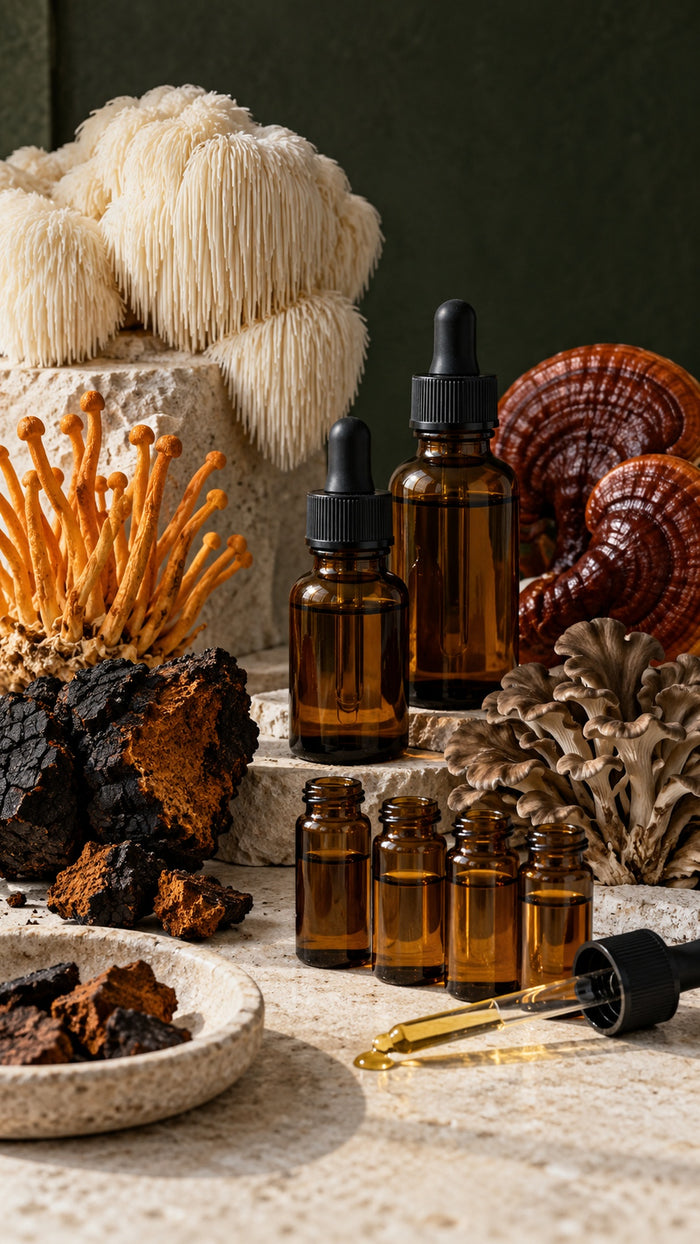
Some commonly available functional mushrooms include:
-
Lion's Mane: Studied for its potential relationship with cognitive health and nerve-related processes.
-
Cordyceps: Traditionally used in various wellness practices and studied for its potential effects on energy metabolism and exercise performance.
-
Chaga: Contains various antioxidant compounds that have attracted scientific interest.
-
Reishi: Traditionally used in herbal practices and studied for its bioactive compounds.
-
Maitake: Contains beta-glucans and other compounds that are being investigated for their biological properties.
Before buying, check the exact mushroom species listed on the label. Also, look at whether the product contains a single mushroom or a blend.
If you are comparing products, make sure you are comparing the same mushroom species. A Lion's Mane extract and a Reishi extract, for example, cannot be compared simply by their extract ratios or prices.
2. Is the Extract Made From Fruiting Bodies or Mycelium?
The source of the mushroom is another important detail to check.
Mushrooms have different parts, including the fruiting body and mycelium. The fruiting body is the visible mushroom, while mycelium is the network of thread-like structures that grows through a substrate.
Some supplements use fruiting bodies, some use mycelium, and others use a combination of both. Some mycelium products may also contain residual grain from the growing substrate.
When comparing products, check:
-
Whether the extract uses fruiting bodies, mycelium or both.
-
Whether the brand clearly identifies the mushroom source.
-
Whether the product contains grain or other substrate material.
-
Whether the source information is supported by the product documentation.
Fruiting body and mycelium can have different compositions. Neither label alone tells you everything about a product's quality, so consider the source alongside extraction and testing information.
3. What Extraction Method Does the Brand Use?
Extraction is an important part of mushroom supplement manufacturing. It determines how the mushroom material is processed and which compounds are targeted for recovery.
Common methods include hot-water extraction, alcohol extraction and combinations of different extraction techniques.
Some manufacturers also use triple-stage extraction, which involves three processing stages. However, the term alone doesn't tell you exactly how the process works.
Vital Vial uses a proprietary enzyme-based triple-stage extraction process. Enzymes are used during processing to help break down mushroom material and support the extraction process.
When evaluating an extract, ask:
-
Does the brand explain its extraction method?
-
Does it use water, alcohol, enzymes or a combination?
-
Are the different extraction stages clearly explained?
-
Does the manufacturer provide evidence to support its extraction claims?
A clearly explained extraction process helps you understand how a product is made. However, a more complex process does not automatically mean a more effective product. The actual composition and testing results also matter.
4. Does the Brand Disclose Its Beta-Glucan Content?
Beta-glucans are naturally occurring polysaccharides found in mushrooms. They are among the compounds commonly examined when evaluating mushroom extracts.
However, not all products disclose their beta-glucan content. Even when a percentage is provided, it's important to understand how it was measured.
Before buying, consider these questions:
-
Does the brand disclose its beta-glucan content?
-
Is the percentage supported by laboratory testing?
-
Does the brand explain the testing method?
-
Is the figure for beta-glucans specifically or total polysaccharides?
For example, Vital Vial reports a beta-glucan content of 3–4% by volume for its Lion's Mane extract. When reviewing this figure, check the measurement basis and the supporting test documentation.
Remember that a higher beta-glucan percentage alone does not establish that one mushroom extract is better than another. The mushroom species, extraction process and testing method all matter when comparing products.
5. Is the Mushroom Extract Independently Lab Tested?
Product labels can tell you a lot, but laboratory testing can provide additional information about what's in a mushroom extract.
Independent laboratory testing involves having a sample analysed by an external laboratory rather than relying solely on the manufacturer's own statements. The tests performed can vary depending on the product and the laboratory.
Depending on the testing programme, relevant checks may include:
-
Beta-glucan content
-
Heavy metals
-
Microbial contamination
-
Other specified quality parameters
Before ordering, check whether the brand explains what it tests, which laboratory performs the testing and whether the results relate to the actual product.
It's also worth remembering that laboratory testing doesn't automatically establish a product's effectiveness or guarantee that every possible quality concern has been assessed.
6. Can You Access the Product's Certificate of Analysis?
A Certificate of Analysis (COA) is a document that reports the results of specified laboratory tests for a product or sample.
For mushroom extracts, a COA can help you understand what has been tested and whether the reported results meet the relevant specifications.
When reviewing a COA, look for:
-
The product name and, where applicable, batch number.
-
The name of the testing laboratory.
-
The date of testing.
-
The parameters tested.
-
The reported results and any relevant limits or specifications.
A batch-specific COA is particularly useful because it connects the test results to a particular production batch rather than relying on general claims about a product.
If a brand makes testing a key part of its quality promise, check whether it makes relevant documentation available. You should also confirm that the COA covers the claims you are trying to verify.
7. What Ingredients and Other Information Are Listed on the Label?
Before ordering a mushroom extract, take a closer look at the product label. The mushroom itself is only one part of the information you need.
A useful product label should clearly state:
-
The mushroom species and source.
-
The form of the extract, such as liquid or powder.
-
The full ingredient list.
-
The quantity and serving information.
-
Directions for use and storage instructions.
-
Relevant manufacturer and product details.
For liquid extracts, check the volume of the bottle and the amount provided per serving. Also, check whether the product contains additional ingredients, such as alcohol, glycerine or flavouring agents.
Avoid relying only on phrases such as premium, high strength or concentrated. Look for measurable product information that allows you to understand what you are purchasing.
8. Is the Brand Transparent About Its Manufacturing Process?
A brand's manufacturing information can help you understand how its products are made and what quality measures it follows.
Look for clear explanations of:
-
Where the mushrooms are sourced.
-
Whether the product uses fruiting bodies or mycelium.
-
Which extraction method is used.
-
How the finished product is tested.
-
Whether batch-level quality information is available.
For Australian buyers, it's also useful to check where the product is manufactured and who is responsible for producing it. Don't assume that an Australian brand necessarily manufactures every product in Australia.
Vital Vial focuses on its proprietary enzyme-based triple-stage extraction and its fruiting-body-only sourcing approach. You can learn more about the company's background and manufacturing approach on its About page .
Transparency makes it easier to understand a brand's processes and assess its claims rather than relying on marketing language alone.
9. How Do You Compare the Price and Value of Mushroom Extracts?
Price is often one of the first things buyers compare. However, the cheapest bottle isn't necessarily the best value, and a more expensive extract isn't automatically higher quality.
Instead of comparing prices alone, consider the following:
-
Serving size: How many servings does each bottle provide?
-
Extract information: Does the brand clearly explain its extraction method and composition?
-
Beta-glucan content: Is the content disclosed and supported by appropriate testing?
-
Testing: Are relevant laboratory results available?
-
Ingredients: Does the label clearly disclose everything in the product?
-
Transparency: Can you easily find information about sourcing and manufacturing?
For liquid extracts, compare the cost per serving rather than just the price per bottle. Also, make sure the products have comparable serving sizes and specifications.
A transparent product page that provides clear information about ingredients, extraction and testing makes it easier to understand what you're paying for.
10. Where Can You Buy Functional Mushroom Extracts in Australia?
Once you've compared the products, the next step is finding a reliable place to order them.
When buying online in Australia, check a few practical details before placing your order:
-
Does the website clearly identify the business?
-
Are the product ingredients and specifications available?
-
Is the price clearly displayed?
-
Are shipping, returns and contact information easy to find?
-
Does the brand provide relevant quality and testing information?
-
Are its product claims supported and appropriate?
Buying directly from a brand's website can make it easier to access its product information and contact the company if you have questions. However, you should still review the product details and applicable Australian requirements before purchasing.
Vital Vial offers a range of functional mushroom extracts. You can explore its Lion's Mane Liquid Extract and visit the Vital Vial website for more information.
Frequently Asked Questions
1. What should I look for when buying a functional mushroom extract?
Check the mushroom species, source, extraction method, ingredient list and available testing information. If the brand discloses beta-glucan content, look for the measurement method and supporting laboratory results.
2. Is a triple-stage mushroom extract better than a single-extraction product?
Not necessarily. Triple-stage extraction involves multiple processing stages, but the number of stages alone doesn't establish product quality. Consider the extraction details, final composition and available testing results when comparing products.
3. Why is beta-glucan content important in mushroom extracts?
Beta-glucans are compounds naturally found in mushrooms and are commonly examined in mushroom extract testing. Knowing the reported content and how it was measured can help you compare product specifications, although the percentage alone doesn't establish effectiveness.
4. What is a COA, and why should I check it?
A Certificate of Analysis reports the results of specified laboratory tests. Checking a relevant, batch-specific COA can help you verify certain product specifications and understand which quality parameters have been assessed.
5. Are liquid mushroom extracts better than capsules?
Neither form is automatically better. Liquid extracts and capsules differ in formulation, convenience, ingredients and serving information. Choose based on your preferences and compare the actual product specifications rather than the format alone.
6. Can I buy functional mushroom extracts online in Australia?
Yes, functional mushroom extracts are available through Australian online retailers and brand websites. Before ordering, check the product information, ingredients, testing documentation, seller details and any applicable Australian regulatory requirements.
Final Thoughts
Choosing a functional mushroom extract involves more than comparing brands or looking at the price of a bottle. Understanding the mushroom source, extraction method, beta-glucan content and testing information can help you make a more informed decision.
Look for brands that explain how their products are made, provide clear ingredient information and make relevant testing documentation available. Be cautious of broad claims that aren't supported by evidence.
Vital Vial's enzyme-based triple-stage extraction, fruiting-body-only sourcing and focus on testing are key aspects of its approach. If you're researching Lion's Mane, you can explore the Vital Vial Lion's Mane Liquid Extract to review its product information before making a decision.
Written by
Priyanka Mishra