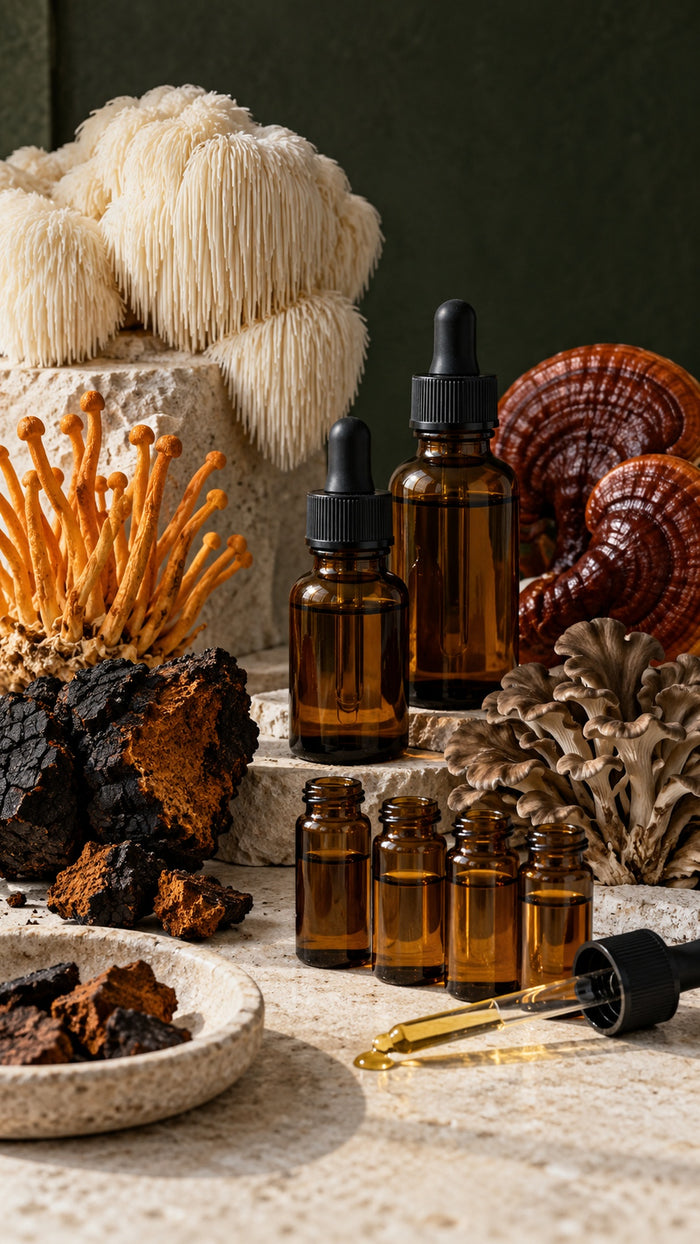
What Is Lions Mane Mushroom?

Lions Mane mushroom (Hericium erinaceus) is a white, shaggy fungus native to North America, Europe and Asia. It grows on hardwood trees and has been used in traditional East Asian medicine for centuries. Today it is studied primarily for its effects on nerve growth factor (NGF) synthesis, cognitive function and neurological health.
Unlike most supplements that claim broad wellness benefits without mechanism, Lions Mane has a well characterised set of bioactive compounds, hericenones and erinacines, that researchers have shown can cross the blood brain barrier and stimulate NGF production in the brain.
Key Bioactive Compounds: What Makes It Different
Two compound classes distinguish Lions Mane from other functional mushrooms:
- Hericenones — found in the fruiting body; shown to stimulate NGF synthesis in vitro
- Erinacines — found in the mycelium; smaller molecular weight, demonstrated ability to cross the blood brain barrier in animal studies
This distinction matters when choosing a product. Fruiting body extracts are standardised for hericenones. Mycelium extracts carry erinacines. Full spectrum products include both. Most published human clinical trials use fruiting body extract standardised to a minimum of 30% polysaccharides.
What the Research Actually Shows
Rather than summarising vague claims, here is what specific peer reviewed studies found:
Cognitive Function in Older Adults
A 2009 double blind placebo controlled trial published in Phytotherapy Research (Mori et al.) gave 30 Japanese adults aged 50 to 80 either 3g of Lions Mane powder daily or a placebo for 16 weeks. The Lions Mane group scored significantly higher on the Revised Hasegawa Dementia Scale at weeks 8, 12 and 16. Scores declined again after supplementation stopped, suggesting the effect was dependent on continued intake.
Anxiety and Depression
A 2010 study in Biomedical Research (Nagano et al.) followed 30 women over four weeks. Those consuming Lions Mane cookies reported lower scores on measures of anxiety, irritability and concentration difficulty compared to the placebo group. The mechanism proposed was NGF stimulation rather than direct serotonergic activity.
Nerve Regeneration
Animal studies published in Evidence Based Complementary and Alternative Medicine (2012, Wong et al.) showed accelerated recovery of crush injured peroneal nerve in rats treated with Lions Mane aqueous extract. The researchers observed faster toe spread reflex return and increased neurofilament expression in treated animals.
Gut and Immune Function
A 2017 study in International Journal of Medicinal Mushrooms found Lions Mane polysaccharides modulated gut microbiota composition in mice, increasing Bifidobacterium and Lactobacillus populations. Given the gut brain axis research emerging in this space, this is an area of growing clinical interest.
How Lions Mane Compares to Other Functional Mushrooms
| Mushroom | Primary Studied Benefit | Key Compounds | Human Trials Available |
|---|---|---|---|
| Lions Mane | Cognitive function, nerve growth | Hericenones, Erinacines | Yes (limited, small sample) |
| Reishi | Immune modulation, stress | Triterpenes, Beta glucans | Yes (immune focus) |
| Cordyceps | Athletic performance, oxygen utilisation | Cordycepin, Adenosine | Yes (exercise performance) |
| Chaga | Antioxidant activity | Inotodiol, Betulinic acid | Mostly preclinical |
What Dose Does Research Use?
The majority of published human trials used between 500mg and 3,000mg of dried fruiting body equivalent daily, with the most commonly cited clinical dose being 1,000mg taken three times daily (totalling 3g). Studies using extracts standardised to polysaccharide content typically used extracts at a concentration ratio of 8:1 or higher, meaning an 500mg extract capsule may be equivalent to 4,000mg of raw powder.
Duration in trials ranged from four weeks (mood outcomes) to 16 weeks (cognitive outcomes), suggesting that meaningful effects require sustained supplementation rather than short term use.
Fruiting Body vs Mycelium: Why the Form Matters
This is one of the most consequential and least discussed distinctions in the functional mushroom category.
Mycelium on grain (MOG) products, common in the US market, are often grown on rice or oats and not fully separated from the substrate before processing. Independent third party testing by the American Herbal Pharmacopoeia and researchers like Jeff Chilton (Nammex) has found some MOG products contain more starch from the grain substrate than actual mushroom material, with beta glucan content as low as 1 to 3% versus 25 to 50% in quality fruiting body extracts.
When evaluating a Lions Mane product, look for:
- Specification of fruiting body vs mycelium (or both)
- Stated beta glucan percentage (aim for 25% or above)
- Starch content disclosure or low alpha glucan levels
- Third party certificate of analysis
Who Is Most Likely to Benefit?
Based on the populations studied in clinical trials, Lions Mane appears most relevant for:
- Adults over 50 concerned about age related cognitive decline
- Individuals managing mild anxiety or low mood without pharmaceutical intervention
- Those recovering from peripheral nerve injury (based on animal data; human trials are limited)
- People seeking long term cognitive support rather than acute nootropic effects
It is not a stimulant and does not produce the immediate effects associated with caffeine or racetams. Users consistently report that effects emerge gradually over several weeks of consistent use.
Safety and Contraindications
Lions Mane has a strong safety profile across published literature. No serious adverse events were reported in clinical trials. However:
- Individuals with mushroom allergies should exercise caution
- A small number of case reports document contact dermatitis and respiratory symptoms in people handling the raw fungus
- Those on immunosuppressant medications should consult a healthcare provider, as Lions Mane demonstrates immune modulating activity
- Pregnant and breastfeeding individuals are excluded from published trials; use is not recommended without professional guidance
Common Questions About Lions Mane
Does Lions Mane work immediately?
No. Unlike stimulant nootropics, Lions Mane works through NGF stimulation, which is a slow biological process. Most trial participants reported noticeable changes after four to eight weeks of daily use. Expecting immediate results is the most common reason people discontinue prematurely.
Can you take Lions Mane every day?
Yes. All published clinical trials administered it daily without cycling. There is no evidence of tolerance development or diminishing returns with continuous use at studied doses.
Is Lions Mane psychedelic?
No. Lions Mane contains no psilocybin or related compounds. It is not a psychedelic mushroom and has no hallucinogenic properties. It is legal in all jurisdictions where dietary supplements are permitted.
What is the best time to take Lions Mane?
Clinical trials do not specify a preferred timing. Anecdotal reports and practitioner guidance suggest morning intake to align with daytime cognitive demands, but no circadian optimisation data exists for this compound specifically.
The Bottom Line
Lions Mane mushroom is one of the most evidence supported functional mushrooms for cognitive health, with a plausible mechanism (NGF stimulation), replicated human trial data, and a strong safety record. The research is not yet at the scale of pharmaceutical trials, but it is substantially more robust than most supplement categories.
The most important variable is product quality. A low quality mycelium on grain product and a high quality fruiting body extract standardised to 30% beta glucans are not interchangeable. The research evidence applies to the latter, not the former.
For anyone exploring Lions Mane, start with the dose used in trials (1,000mg three times daily or equivalent), use a standardised fruiting body extract, and assess over a minimum of eight weeks before drawing conclusions.
Written by
Priyanka Mishra