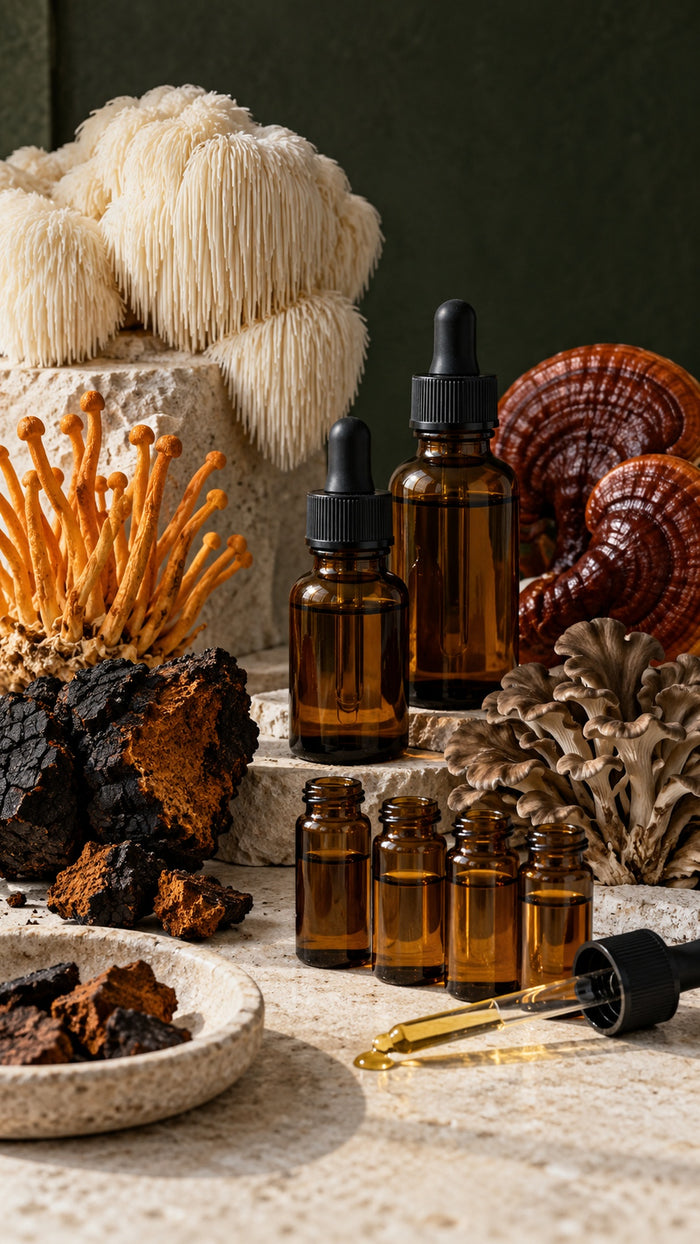
Lions Mane Extract: What Should You Look For?

If you have read our guide on What Is Lions Mane Mushroom?, you already know that the evidence behind this functional fungus is more robust than most supplement categories. But here is the part that guide cannot tell you: the research applies to specific extract types, at specific potencies. The product you purchase may or may not reflect those conditions.
This guide is built around the variables that actually determine whether a Lions Mane extract delivers what the clinical literature promises, with numbers, not vague quality language.
Why Extract Quality Varies So Dramatically
Lions Mane supplements occupy the same shelf space despite being fundamentally different products. Independent laboratory testing commissioned by researchers including Jeff Chilton of Nammex, one of the most cited sources on mushroom extract quality — has found beta glucan content ranging from under 1% to over 45% across commercially available products. Both products may be labelled "Lions Mane Extract 500mg."
The variation comes from four factors: what part of the mushroom was used, what it was grown on, how it was extracted, and whether the final product has been independently verified. Each factor is addressable before you buy.
Factor 1: Fruiting Body vs Mycelium vs Full Spectrum
This is the single most consequential variable in Lions Mane extract quality.
Fruiting Body
The fruiting body is the visible mushroom — the white, shaggy structure that grows from hardwood. It is the source material used in virtually all published human clinical trials, including the landmark 2009 Mori et al. study that demonstrated cognitive improvements in adults aged 50 to 80. Fruiting body extracts are rich in hericenones, the compounds shown in vitro to stimulate nerve growth factor (NGF) synthesis.
High quality fruiting body extracts typically test at 25 to 50% beta glucans by dry weight. Beta glucans are the primary bioactive polysaccharides and serve as the most reliable proxy for mushroom content and potency.
Mycelium
Mycelium is the root network of the fungus. It contains erinacines, which have demonstrated ability to cross the blood brain barrier in animal models and may have complementary neuroprotective effects. However, most commercially available mycelium products are grown on grain substrates (rice, oats) and are not fully separated from that substrate before processing — a category known as mycelium on grain (MOG).
MOG products frequently test below 5% beta glucans because the starch from the grain substrate dilutes the active mushroom content. A 2017 analysis by the American Botanical Council found that several leading MOG products contained more starch than fungal material by dry weight.
Full Spectrum
Full spectrum products combine fruiting body and mycelium extracts that have been properly separated and concentrated. When both components are genuinely present at meaningful levels, this represents the most complete bioactive profile. Look for products that specify beta glucan and erinacine content independently, not just as a combined total.
Factor 2: Beta Glucan Content — The Number That Matters Most
Beta glucans are the structural polysaccharides found in the cell walls of fungi. They are the primary immunomodulatory and bioactive compounds in medicinal mushrooms and the most reliable indicator of extract quality. They are also the compounds most diluted in low quality products.
Here is what the numbers mean in practice:
- Below 5% beta glucans: Almost certainly a mycelium on grain product with significant substrate dilution. Not aligned with clinical trial material.
- 5 to 15% beta glucans: Marginal. May reflect partial separation from substrate or lower grade fruiting body material.
- 25 to 35% beta glucans: Consistent with quality fruiting body extract. Aligns with the material used in the majority of clinical studies.
- 35 to 50% beta glucans: High potency extract, typically achieved through additional concentration steps. Appropriate for lower dose capsules where potency per gram needs to be higher.
Most brands do not list beta glucan content on their label. If it is absent, ask for the certificate of analysis before purchasing. If the brand cannot provide one, that is itself a quality signal.
Factor 3: Extraction Method
Raw or powdered mushroom material requires an extraction step to make the bioactive compounds bioavailable. The cell walls of fungi are composed of chitin — a structural polymer that the human digestive system cannot break down efficiently. Without extraction, most of the beneficial compounds pass through unabsorbed.
Hot Water Extraction
Hot water extraction is the traditional method used across East Asian herbal medicine and the method used in most clinical research. It effectively extracts beta glucans and other water soluble polysaccharides. This is the minimum standard for a quality Lions Mane product.
Dual Extraction (Hot Water and Alcohol)
Some compounds in Lions Mane — particularly certain hericenones — are not fully soluble in water alone. Alcohol (ethanol) extraction captures these fat soluble constituents. Dual extraction products include both water soluble and alcohol soluble fractions, providing a broader bioactive profile. For Lions Mane specifically, the incremental benefit over hot water extraction alone is still being characterised in the literature, but dual extraction is generally considered the more thorough approach.
What to Avoid
Products that list only "raw powder" or "whole mushroom powder" without specifying extraction have likely not undergone the processing required to break down chitin and make compounds bioavailable. These products may still contain beta glucans on lab testing, but absorption in vivo will be significantly lower.
Factor 4: Substrate and Growing Conditions
Lions Mane grown on its natural substrate — hardwood — produces a meaningfully different chemical profile to Lions Mane grown on grain. This is not theoretical. A 2021 study published in Frontiers in Microbiology found that substrate composition directly influenced both the yield and the hericenone concentration in the resulting fruiting body. Hardwood substrate produced consistently higher concentrations of bioactive hericenones compared to grain based alternatives.
For mycelium products, grain substrate is the norm for cost reasons. For fruiting body products, look for specification of log grown or hardwood substrate cultivation. Brands sourcing from certified organic hardwood farms in China, Japan or the US are more likely to produce material aligned with research grade standards.
Factor 5: Third Party Testing and Transparency
Self reported quality claims mean very little without independent verification. In the supplement industry, which is not pre-market approved by the TGA in Australia for specific efficacy claims, the burden of evidence falls entirely on the brand's own testing practices.
What to look for:
- Certificate of Analysis (CoA) from an accredited third party lab — should specify beta glucan percentage, alpha glucan (starch) percentage, heavy metals and microbial counts
- Batch specific testing — a CoA dated two years ago does not verify current product quality
- Alpha glucan disclosure — high alpha glucan (starch) content relative to beta glucan is the clearest indicator of undisclosed grain substrate contamination
- TGA listing or GMP certification — in Australia, listed medicines (AUST L number) require adherence to Good Manufacturing Practice standards
How to Read a Lions Mane Label
A well labelled Lions Mane extract should tell you:
- Whether it uses fruiting body, mycelium or both
- The extraction ratio or concentration (e.g. 8:1 meaning 8kg of raw material per 1kg of extract)
- Beta glucan percentage per serving
- Extraction method (hot water, dual extraction)
- Substrate or source region
If a label says only "Lions Mane Mushroom Extract 500mg" with no further specification, you cannot determine whether the product is aligned with clinical research. That ambiguity is almost always resolved in the brand's favour, not the consumer's.
Dose: What Research Used vs What Products Provide
As covered in our pillar guide on Lions Mane, most human trials used 3g of dried fruiting body equivalent per day, divided across doses. When using a concentrated extract, the math changes:
- An 8:1 extract at 500mg per capsule is equivalent to approximately 4,000mg of raw dried mushroom
- Two capsules per day of an 8:1 extract would exceed the dose used in the 2009 Mori et al. cognitive trial
- A raw powder product at 500mg per capsule would require six capsules daily to reach the same threshold
This means concentration ratio is not just a quality marker — it is directly relevant to whether you are likely taking an effective dose at the recommended serving size on the label.
Liquid Extracts: A Note on Bioavailability
Liquid extracts offer some practical advantages over capsules and powders. Because the extraction has already occurred in liquid form, the compounds are in solution and do not require capsule dissolution before absorption begins. For individuals with compromised digestive function or those who prefer sublingual delivery, a high quality liquid extract can be a meaningful format difference.
Our Lions Mane Liquid Extract uses dual extracted fruiting body material standardised for beta glucan content, sourced from hardwood grown mushrooms and batch tested by third party laboratories. It is one of the formats closest to the extraction methods used in clinical research.
Summary: What a Quality Lions Mane Extract Looks Like
| Variable | Lower Quality Indicator | Higher Quality Indicator |
|---|---|---|
| Source material | Mycelium on grain, unspecified | Fruiting body or verified full spectrum |
| Beta glucan content | Not disclosed or below 5% | 25% or above, third party verified |
| Extraction method | Raw powder, no extraction stated | Hot water or dual extraction specified |
| Substrate | Grain (rice, oats) | Hardwood, log grown |
| Testing | Self certified or no CoA available | Batch specific third party CoA available |
| Concentration ratio | Not stated | Stated (e.g. 8:1, 10:1) |
Frequently Asked Questions
Is a higher mg dose always better?
No. A 1,000mg raw powder capsule may deliver fewer active compounds than a 250mg concentrated extract. Milligrams alone are meaningless without knowing concentration ratio and beta glucan content. Always compare products on beta glucan content per serving, not total milligrams.
Does organic certification matter for Lions Mane?
It matters primarily as a proxy for substrate purity and pesticide absence, not as a direct marker of potency. An organic certified grain substrate product still has the starch dilution problem. Organic certification is a floor standard, not a ceiling one.
Can I get Lions Mane from food instead of supplements?
Fresh Lions Mane mushroom is available in some specialty grocers and Asian food markets. It has genuine nutritional value and culinary use. However, achieving the doses used in cognitive trials through food consumption alone would require eating approximately 150 to 300g of fresh mushroom daily — impractical for most people and economically inefficient. Standardised extracts remain the most reliable route to clinical dose alignment.
How long before I know if a product is working?
As outlined in our Lions Mane overview, the mechanism is NGF stimulation — a slow biological process. Allow a minimum of eight weeks of consistent daily use before assessing. Cognitive and mood outcomes were most reliably detected at the 12 to 16 week mark in published trials.
Written by
Priyanka Mishra